
Found a young bird in Berlin: nestling or fledgling?
Allgemein
July 13, 2018
Have you found a young bird? Please wait at first and watch the situation. Many young birds look helpless but are still being cared for by their parents. Whether a bird needs help depends above all on whether it is a nestling or a fledgling. In this guide you will learn how to tell them apart and when you should step in.
Nestling or fledgling: the difference
Nestlings are naked or have hardly any feathers. Outside the nest, the adult birds do not feed them or keep them warm. They are defenceless against predators. Nestlings that have been found therefore urgently need help.
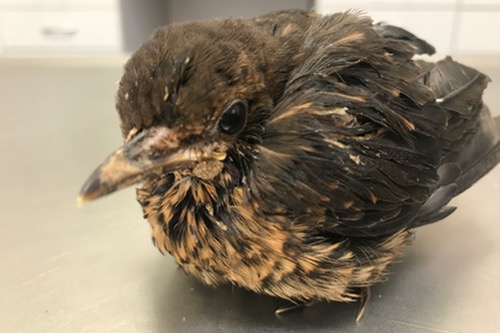
Fledglings are fully feathered. They are in the so-called begging-flight phase and have left the nest of their own accord. Many birds fledge before their plumage is fully developed. Fledglings keep begging their parents for food and are well looked after by them.
Found a nestling: back into the nest
If the nestling is uninjured, look for its nest near the spot where you found it. Gently put the little bird back inside. Most birds have only a weak sense of smell. So the “human scent” will not stop the parents from caring for it.
Only take a nestling into your care if it is injured or if the nest is destroyed, cannot be found or cannot be reached. The same applies if both parents have demonstrably died.
Found a fledgling: watch, don’t take it
Is a fledgling sitting on the ground or in a bush, alone or with its siblings, and does it look healthy? Then watch it from a good distance, for example with binoculars, for one to two hours. Young birds stay in vocal contact with their parents. As soon as you move away, the parents usually return with food. A bird like this does not need human help.
If the bird is in danger
Only step in if the bird is in immediate danger, for example at the roadside or from a predator. Then pick it up carefully and put it in a bush or hedge. Stay within 25 metres of the spot where you found it, so that the parents can find it again.
Exceptions: swifts and swallows
Swifts found on the ground are an exception, as are, in most cases, house martins and barn swallows: they are in acute distress.
Found a bird in Berlin: where to go?
Sometimes a bird is injured, or the parents have not looked after it for several hours. In that case, contact a suitable rescue centre, for example the NABU wild bird station. Raising a young bird is very intensive, lengthy and demanding. It should therefore only be done by trained and experienced rescue centres.
Injured young bird: see a vet
Injured young birds, whether nestlings or fledglings, should be seen by a vet. Our practice on Scharnweberstraße is open around the clock. Tips on transporting wild animals and birds are in our advice on wild animals.
Frequently asked questions about finding a young bird
Can I touch a young bird?
Yes, if necessary. Most birds have a poor sense of smell, so the parents will still accept their young.
How long should I watch a fledgling?
Watch it from a good distance for one to two hours. The parents usually come to feed it during this time.
Can I raise a young bird myself?
We advise against it. Raising a young bird is very demanding and belongs in the hands of an experienced rescue centre.
Found an injured bird? Call us on 030 / 412 73 57. We can be reached 24 hours a day, including Sundays and public holidays. Read more about pet birds in our advice for bird owners. Our emergency care is described under Services, and all the ways to reach us are on the contact page.